¶ Hybrid Belts
In this chapter, we will install the hybrid belts so that we can continue the calibration process.
- Follow the dedicated guide explaining how to route the Y-belts.
¶ 01. Belt Tension and Gantry Alignment
Warning! Before starting:
- You verified during assembly that the gantry moved freely without the belts, and is aligned correctly.
- All belts have been fitted with enough tension to allow the motion system to work.
- The previous chapter "Sanity Check" has been completed successfully.
- Home all axes on the machine by clicking "HOME ALL".

-
Now let's position the gantry to start the process. Insert 272mm in the Y axis position.
-
Slightly loosen the screws highlighted in the image (the ones securing the 2020 aluminum extrusion).

- Run the following command in your console:
M18
- Please download and install the Smart Belt Drive app from the App Store or Google Play Store.
Note! We suggest this app but you are free to choose another one. The most important thing is that the frequencies that you are measuring are right. So be aware that this is crucial and it will impact your machine performance.
-
Open the "Frequency Measure".
-
Click the red button to start recording the frequency.
-
It's time to pluck your belt!
Note - How to pluck:
- Use your fingertip, fingernail, or a thin pick to pull the belt slightly outward and release it quickly.
- Do it perpendicular to the belt (like plucking a guitar string).
- Always pluck in the same spot, right in the middle of the belt section where you're performing the pluck.
- Make the pluck quick and consistent, don't press or dampen the belt vibration afterwards.
- Repeat 3–5 times in the same spot with the same strength.
- Notice the belts that are highlighted — these are the ones you'll need to pluck, on both sides of the machine.

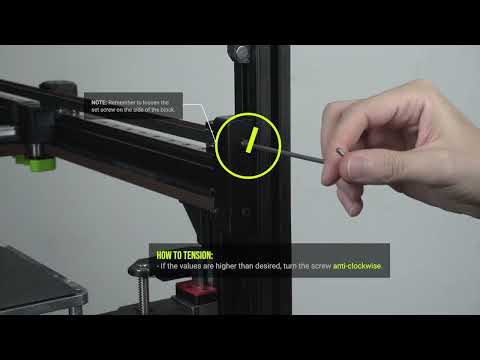
Note - How to adjust tension:
- Whenever frequency values are higher than desired, turn the tensioner block screw anti-clockwise (as a rule of thumb, a quarter turn corresponds to roughly a 10 Hz adjustment).
- If the values are below the desired level, turn the screw clockwise.
- Remember to loosen the set screw on the side of the block.
- Important Note: Your Left and Right Belt needs to have the same frequency values.
- If you are getting frequency readings around ~30 Hz or ~130 Hz, you need to repeat the plucks, those frequencies correspond to an incorrect harmonic. Make sure you obtain at least three consistent frequency readings.
-
Tension the Hybrid belts, aiming for 84 Hz (+-1Hz).
-
Tension the CoreXY belts, aiming for 87 Hz (+- 1Hz).
-
Because adjusting the CoreXY tension can affect the Hybrid tension, we need to check the Hybrid tension again. Repeat steps 10 and 11 until all the belts are plucking with the correct frequency.
-
Now that you've tensioned the belts and reached the desired frequency, we'll proceed with the fine adjustment.
- Move the toolhead(s) to the center of the machine (they must be clear of the motor cages and any PTFE tube guides).
- Gently slide the gantry fully to the back until the joiners contact the stepper motor cages.

- Press both joiners against the stepper motor cages. You will probably feel that one side is making firm contact, and the other has some play. We need to adjust the balance of corexy belt tension until both sides are making firm contact at the same time with no play.
If both sides are making firm contact, no further adjustment is required.
Otherwise, identify the side that does not make firm contact.
- Loosen only the lower set screws on both the left and right tensioner blocks.
Note - Explanation Block:
We will need to slightly decrease the tension on the identified side by turning the tension screw anti-clockwise, and slightly increase the tension on the other side by turning the screw clockwise.
To avoid causing excessive gantry twist, make any adjustments symmetrically on both sides but in opposite directions.
For example, if you tighten the right tensioner, slightly loosen the left tensioner. Do not attempt to straighten the gantry using only one side.
-
Make small adjustments until both joiners make firm contact with the stepper motor cages at the same time.
-
Tighten the gantry screws that were slightly loosened in step 5.
¶ 02. Belt tension - Advanced users only
If you don't feel comfortable analyzing the belt tension graphs, you can move on to the next topic, 04. Input Shaper, where you'll perform part of the diagnostic process that can be done using the belt tension graph.
Belt tension graphs are meant to help diagnose your machine assembly rather than serve as a tuning tool. It's easy to over-focus on them, but they should be seen as a guide for spotting issues rather than a perfect benchmark. Belt tension analysis is a nuanced and evolving subject; for deeper exploration, check out the excellent work by the Klippain Shaketune team.
Warning! Ensure your machine build is complete, wiring is clean, no parts are loose, and the printer is placed on a sturdy surface with nothing resting on or against it. Do not touch the machine during vibration analysis.
This procedure focuses on relative belt tension—verifying that both belts are equally tensioned, which is crucial for smooth motion. Ideally, the belt graph for a V-Core 4 will show smooth lines with two peaks, as illustrated below.

To perform a belt tension graph, just click on the designated button inside the "SCRIPTS" window.

You must now analyse your graph and identify potential issues. This is a very complex and involved process, but here are a few generic most found issues:
-
The two peaks (blue and orange) must be aligned on the same frequency, if they are not vertically aligned, then you need to tension or loosen the belts, and your gantry is most likely twisted. Refer to this guide to help you troubleshoot.
-
Toolhead vibrations typically appear in the 100–150 Hz range and can result from loose screws, damaged printed parts, unsecured wires, or insufficient cable management (e.g., missing zip ties).

-
There is an issue with the belt path: If your graph lacks one or two peaks. It likely means a belt is rubbing against something along its path, such as an idler, motor pulley, or the frame.
- 3.1. In the example below, only one belt path is affected.

- 3.2. In the example below, both belt paths are affected.

-
Lastly, it's important to distinguish between vibrations and swinging.
- 4.1. Vibrations appear as zig-zag patterns on the graph and are usually caused by loose screws on the toolhead or gantry. Loose idler stacks or missing shims can produce the same effect. Carefully inspect the assembly to identify and correct the source.

- 4.2. Swinging appears as smooth curves on the graph and is often caused by the printer resting on an unstable table or uneven floor. Ensure your machine is on a solid, level surface to prevent it from shaking.

¶ 03. Input Shaper
This calibration follows the Klipper documentation steps but they are simplified for the V-Core 4.
- Open the SCRIPTS window and click GENERATE SHAPER GRAPHS.

- After completion, open the machine tab (1) and navigate to the input_shaper (2) folder.

Note! You will find two files. Each file name indicates the axis (X or Y), and the timestamp.

-
Open every graph and register the MZV resonance frequencies. These values will be used in the next step when editing the printer.cfg file.
-
Open the machine (1) tab and then open the printer.cfg (2) file.

Note!
Example: MZV (46.4 Hz, vibr:0.0%, sm~=0.09, accel<=6300)
Notice that this protocol recommends a maximum acceleration of 6300 mm/s². You must compare this value with the one indicated on the X-axis graph and use the lower of the two. That value should be set as your external perimeter acceleration in the slicer profile to minimize visible ghosting. The default external perimeter speed and acceleration in the V-Core 4 profiles are somewhat conservative, and you may increase them based on your Input Shaper results to achieve the best balance between print quality and performance.
- Copy the code below. Open 'printer.cfg', then scroll down until you see the heading for 'User Overrides'. Paste the code under the 'User Comments' heading. Then replace 'Your_X_Frequency' and 'Your_Y_Frequency' with the corresponding MZV resonance frequencies from step 3.
[input_shaper]
shaper_freq_x: Your_X_Frequency
shaper_type_x: mzv
shaper_freq_y: Your_Y_Frequency
shaper_type_y: mzv
- Click "SAVE & RESTART" at the top right of the printer.cfg page.
¶ 04. Resonance analysis
The real-time analysis tool enables real-time resonance analysis of your printer. This functionality allows you to set the printer to resonate at a specific frequency and direction, facilitating a detailed mechanical assessment. With this tool, you can more effectively diagnose potential mechanical issues within the machine. Find more detailed information about this tool here.
Note: Discover how this diagnostic tool works and how you can apply it.
-

-
If the incorrect toolhead moved, it means the X stepper and DC stepper connectors on the Octopus board are swapped. Disconnect the machine from power and swap the connectors. Check the wiring diagram here.
-
1. Click on the Real-Time Analysis button (1) in the left menu.
-
2. Select the Accelerometer (2).
-
3. Click Start (3) to activate the accelerometer readings.
-

-
4. Select the resonance direction (4):
-
4.1. Use 'Oscillate X' to debug an X-axis Input Shaper spike or noise.
-
4.2. Use 'Oscillate Y' to debug Y-axis Input Shaper spikes or noise.
-
4.3. Use 'Oscillate X-Y' to diagnose resonance in the lower belt line within the belt graph.
-
4.4. Use 'Oscillate X+Y' to analyse resonance in the top belt line within the belt graph.
-
5. Choose the Oscillation Frequency (5) at which you want the machine to resonate.
¶ 05. Beacon set-up
RatOS provides fully automated Beacon Contact model calibration and temperature offset adjustment. Learn more here.
Warning! The extruder and hotend must be free of filament. Make sure to unload it first, otherwise the machine will not be able to perform this calibration accurately.
-
Install the flex plate.
-
This test will show you the quality of your Beacon probing. Run the following command in your console:
BEACON_POKE_TEST
Check the console output - it should look similar to this:

- Compare your latency values with the following list.
| Score | Notes |
|---|---|
| 0-1 | Extremely low noise, rarely achieved |
| 2-4 | Excellent performance for a typical printer |
| 5-8 | Acceptable performance, machine may have considerable cyclic axis noise |
| 9-11 | Not ideal, may want to verify proper mounting or use thinner stackups |
| 12-14 | Reason for concern, present setup may be risky to continue with |
- RatOS comes with built-in temperature expansion calibration and compensation. To calculate this value run the following command:
BEACON_CALIBRATE_NOZZLE_TEMP_OFFSET
The process will take some time to complete. Check the console output - it should look similar to this:

The result is automatically saved to the configuration file - no user action is required.
¶ 06. Compensation Mesh
The Beacon Scan Compensation feature in RatOS allows you to compensate for these effects by creating a compensation mesh that corrects proximity measurements based on the actual measured distance between the nozzle and the bed surface at multiple locations across the bed.
- To enable scan compensation, add the following to your printer.cfg:
[gcode_macro RatOS]
variable_beacon_scan_compensation_enable: True
variable_beacon_scan_compensation_profile: "auto"
- To create a compensation mesh run:
BEACON_CREATE_SCAN_COMPENSATION_MESH BED_TEMP=85
Note! Use your target temperatures for the "BED_TEMP=".
Example: PLA — BEACON_CREATE_SCAN_COMPENSATION_MESH BED_TEMP=60
The compensation mesh creation process automatically determines the appropriate mesh name based on the bed temperature. Alternatively, you can specify a custom profile name using the PROFILE parameter, for example:BEACON_CREATE_SCAN_COMPENSATION_MESH BED_TEMP=85 PROFILE="PEI_PC_85"
You'll need a compensation mesh for each build plate and for different bed temperature ranges.
Warning! Make sure the nozzle is clean and that no filament is leaking out of it.
- Print a 150x30mm single layer rectangle in the middle of the build plate.

-
While printing, if necessary, fine-tune using baby stepping.
-
Click the SAVE button in the Mainsail Z-OFFSET section to save the adjustment, or run the Z_OFFSET_APPLY_PROBE command.
¶ 07. Skew Calibration
Skew correction is meant to compensate for a 3D printer assembly which is not perfectly square, the software makes small changes to the toolhead movement, maintaining a perfectly square trajectory. Every detail during the frame assembly may cause a slightly twisted frame, even the screws tightness. Making sure the machine is as square as one can get by hand is very important before advancing to software skew calibration.
The V-Core 4 has a 3-point kinematic bed levelling system that helps to mask XZ and YZ skew problems. If the build was successful and all Z rails are properly aligned, the Z squareness shouldn't be a problem, otherwise, a skew calibration should be done for all planes. In this guide we'll only focus on the XY plane, the procedure is the same for the other axis, more information here.
- Start by downloading the Skew_correction_tool.stl. Then open it inside your slicer. If this is your first time following this guide, please follow the Slicer installation first, then get back to this step.
Caution. When slicing the model, make sure the A corner is pointing to the origin of the print area.

- Guarantee that no skew correction is running on your machine, check that variable_skew_profile is commented out in the macro configuration section. or type the command below in the terminal. For more information, click here.
SET_SKEW CLEAR=1
The [skew_correction] module requires 3 measurements; the length from Corner A to Corner C, the length from Corner B to Corner D, and the length from Corner A to Corner D.

Let's take the following measurements as an example:
AC= 141.15mm
BD= 140.9mm
AD= 99.65mm
- Go into the printer.cfg and add the following lines:
[gcode_macro RatOS]
variable_skew_profile: "my_skew"
- Click "SAVE AND RESTART" at the top right of the printer.cfg window, then run the following command in your console:
NOTE: Replace the "AC, BD, AD" text with your values.
SET_SKEW XY=AC,BD,AD
Note! With the previous example, we have:
SET_SKEW XY=141.15,140.9,99.65
- Run the following command in your console:
SKEW_PROFILE SAVE="my_skew"
- Run the following command in your console:
SAVE_CONFIG
- Re-print the test, make sure AC=BD. If not, double check all measurements and start this calibration again.
¶ Next Guide
- Continue to the next guide: 04. Operation & Slicer